When Brutality Replaces Protection — Why Our Communities Must Build Resilience Now
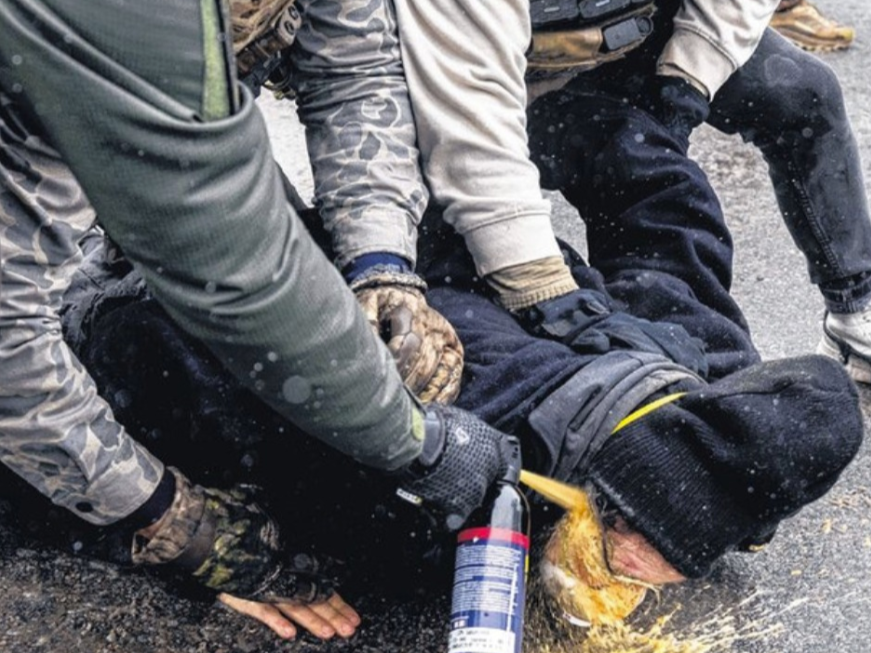
Protester being pepper sprayed by ICE Agents
Yes, there is a line between enforcing the law and killing human beings; that line needs to be drawn and redrawn, particularly in cases of families, children, and civilians who are not involved in violence. And yet, in city after city across this country, that line is being trampled under the boots of federal immigration agents, and we're left with fear, trauma, and a feeling that the institutions are no longer trying to protect us all.
Shooting at peaceful observers to kill them, using pepper spray and other chemical irritants against peaceful demonstrators and bystanders, is horrendous, but the federal appeals court nevertheless decided that ICE can arrest peaceful demonstrators on the streets of Minnesota with that force. The federal appeals court even overruled another court decision that the judge said violated the First Amendment rights of the parties.
This is not an isolated incident. It is government agents deploying chemical weapons on public streets and in public spaces, often with no immediate threat whatsoever, and it's in the communities where children, old people, and families are living their daily lives.
Medical professionals have noted that tear gas, pepper-spray pellets and other "less-lethal" munitions can cause serious injury including blindness, pneumonitis and long-term lung damage, particularly in infants and small children.
When we see toddlers looking out the window hoping to see their parents being dragged away, or a 1-year-old kid being sprayed with gas and appearing to be trying to open their eyes, or we see credible reports of children and adults in the parking lot of a daycare being sprayed in the face with chemical sprays by federal agents, it's heartbreaking.
What we're seeing here is not only vicious policing. It's a daily attack on the stability of our communities. And the consequences are not just physical injuries: the children have become frightened to leave home. Parents are afraid to go to work or pick up groceries.
None of us should be worried about walking down our neighborhoods. But our federal agents, with all their weapons, and lack of accountability, treat our neighborhoods like war zones.
This is not safety. This is intimidation. This is the erosion of the social fabric which holds us all together. Community resilience, our ability as neighbors, family and organizations to support each other in times of crisis, is not a luxury. It is, as always, the foundation of our survival.
All vulnerability takes on exaggerated form, for all state power is exercised without restraint. In periods of acute economic crisis, capital mobility is impeded. If a child is not raised in an atmosphere of safety, it can negatively affect their mental health. Citizens are less likely to participate when they are afraid.
We've seen ordinary people push back in deeply courageous ways: through mass protests and economic boycotts, through lawsuits and mutual aid networks. And they're doing it not just out of outrage, but love: love for their families, their neighbors, their values, and the values that this nation claims to uphold.
But we must do more than resist; we must rebuild.
We must bring grassroots structures to every person, from the right to access to an advocate, to the need for mental health care, to the preservation of schools, parks, public spaces, and the lesson to our kids that the safety of their community is more important than an act of confrontation. Those who hold power must likewise be held to account, and never have a government become a tool of the people and a terror.
But our communities must know that, in order to be not just to survive, but to thrive, the community is stronger than the state that terrorizes it, and that strength begins with us: informed and united, in defense of the dignity of all people. That is why this is an action plan in principle. When people are frightened, countries are divided. But where people come together and build communities of resilience, no measure of force can withstand that.
We owe that to every child who is out there, for nothing more than wanting to play, and to every parent trying to provide hope, and to every human being who deserves to be treated with dignity.
Let's build resilience, and let's build it now.
#PreparedNotPoliced
#DisasterPreparedness
#CommunityCare
#SafeCommunities
#PublicSafetyForAll